

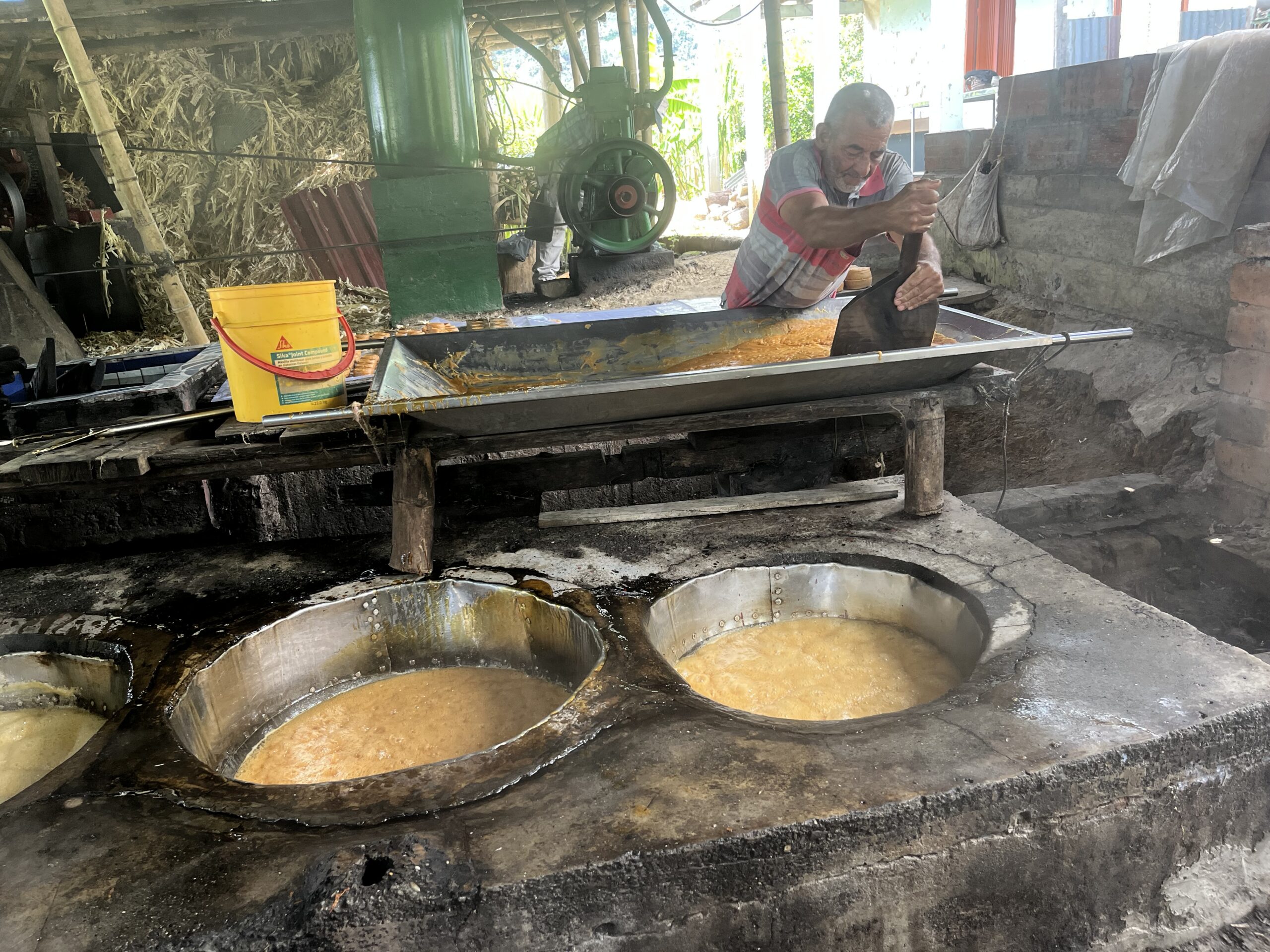
The story of panela begins long before it reaches a Colombian kitchen. It starts in the sugarcane fields, where farmers harvest tall green stalks, and continues at traditional trapiches (sugarcane mills), where generations of knowledge turn freshly pressed juice into one of Colombia’s most cherished ingredients.
Step into a rural trapiche and you will find more than a production process. You will meet the people who make it possible: farmers who know the land, workers who judge the syrup by its colour and consistency, and families who keep this tradition alive through years of hands-on experience.
For travellers, discovering panela is an opportunity to connect with the people and rural communities behind Colombia’s everyday flavours.
A Tradition Shaped by Many Hands
Across Colombia’s Andean countryside, particularly in regions such as Antioquia, Santander, Boyacá and Cundinamarca, sugarcane cultivation supports rural livelihoods. Small-scale producers and their families play an important role in transforming the harvest into panela, often combining traditional methods with practical knowledge passed down through generations.
The work begins in the fields. Farmers harvest mature sugarcane and transport it to the mill, where heavy rollers squeeze out its sweet juice. Workers then heat the liquid in large metal pans, removing impurities and gradually concentrating it over a furnace.
As the water evaporates, the juice thickens and darkens. Workers monitor the heat, colour and consistency, relying on experience to determine when the syrup is ready. Once it reaches the right stage, they beat and cool the mixture before pouring it into moulds to harden.
Every step requires coordination, patience and skill. The heat around the furnace can be intense, and the work is physically demanding. Yet it is precisely this hands-on expertise that gives traditional panela production its distinctive character.
More Than a Sweetener
Panela is deeply woven into Colombian food culture, but its significance extends beyond the kitchen. Its production connects farming families, agricultural workers and local businesses, helping sustain rural communities and preserve traditional knowledge.
In Colombian homes, panela sweetens coffee, adds flavour to desserts and forms the basis of aguapanela, a simple drink made by dissolving it in hot or cold water. Served with cheese, a squeeze of lime or a traditional snack, it is a familiar taste of everyday life.
Unlike refined white sugar, panela retains some naturally occurring minerals, although it remains a concentrated source of sugar. Its real cultural value lies in the traditions, livelihoods and human stories connected to its production.
Meet the People Behind the Process
Visiting a traditional trapiche offers a different perspective on Colombia. Instead of simply tasting a local product, you can learn directly from the people who cultivate the sugarcane, operate the machinery and preserve the skills behind its production.
Their stories reveal the realities of rural life, the challenges of agricultural work and the pride that comes from maintaining a longstanding tradition. They also show how a seemingly simple ingredient connects the countryside to homes and tables across the country.
These encounters are what make travel meaningful: taking the time to listen, ask questions and appreciate the knowledge that local communities share.
Experience Colombia beyond the guidebook. With KonTour Travel, discover the people, flavours and rural traditions that bring the country’s cultural heritage to life.
Curious to see how sugarcane becomes panela? Head over to our Instagram for a glimpse inside a traditional trapiche, where you can watch the process unfold and meet the craftsmanship behind this Colombian staple. Sometimes, seeing the people at work tells a story that words alone cannot capture.
